Your cart is currently empty!

SAUDADE TORONTO
Sophia-Sena As Cartas
$42.00

SAUDADE TORONTO
Sophia-Sena As Cartas
$42.00
Author: Sophia de Mello Breyner Andresen & Jorge de Sena Language: Portuguese,
Este volume reúne a troca epistolar entre Sophia de Mello Breyner e Jorge de Sena, desde o ano que marcou o exílio do escritor no Brasil até à data da sua morte.
O resultado é um impressionante retrato social, histórico e moral do Portugal dos anos 60 e 70.
Retrato de um país perdido. Retrato de «dezoito anos de ausência que poderiam ter sido dezoito anos de convívio, de encontros, conversas, riso comum, aflições e alegrias comunicadas.»
English overview
This volume brings together the correspondence between Sophia de Mello Breyner and Jorge de Sena, from the year that marked the writer's exile in Brazil until the date of his death.
The result is an impressive social, historical, and moral portrait of Portugal in the 1960s and 70s.
A portrait of a lost country. A portrait of "eighteen years of absence that could have been eighteen years of companionship, of encounters, conversations, shared laughter, shared anxieties and joys."
Author
Sophia de Mello Breyner Andresen (Oporto, November 6, 1919 – Lisbon, July 2, 2004) was an award-winning Portuguese poet and writer.
Sophia, as she is often referred to in Portugal, was born in Porto to a wealthy aristocratic family. She inherited the surname ‘Andresen’ from her paternal grandfather, a Danish merchant. She received a strict Catholic upbringing, and was to remain a fervent believer until the end of her life. After spending her childhood in Porto she moved to Lisbon, where she attended the Universidade de Lisboa. As a student, she was activelly involved in Catholic movements. Politically, she defended constitutional monarchy and openly criticized Salazar’s dictatorship. In 1946 she married lawyer and politician Francisco Sousa Tavares. They had five children, among whom journalist and best-selling author Miguel Sousa Tavares. After the Carnation Revolution in 1974, she made a brief incursion into politics as an MP for the Socialist Party (centre-left).
Andresen won acclaim as a storyteller with Contos Exemplares (Exemplary Tales),”Histórias da Terra e do Mar” (Stories of Land and Sea), and a number of children’s books – A Menina do Mar (The Sea Girl), O Cavaleiro da Dinamarca (The Danish Knight), A Floresta(The Forest), O Rapaz de Bronze (The Bronze Boy), A Fada Oriana (The Fairy Oriana). She also published several poetry books and anthologies, including: Poesia, Dual, Livro Sexto, Coral, Dia do Mar, No Tempo Dividido, Grades, O Nome das Coisas, As Ilhas, Antologia, Geografia, Navegações, O Búzio de Cós. In 1999 she became the first woman to receive the highest Portuguese award for poetry, the Prémio Camões. She was also awarded the Spanish Premio Reina Sofia in 2003.
“Poetry,” she explained, “is my understanding of the universe, my way of relating to things, my participation in reality, my encounter with voices and images. This is why the poem speaks not of an ideal life but of a concrete one: the angle of a window, the resonance of streets, cities and rooms, the shadow cast by a wall, a sudden face, the silence, distance and brightness of the stars, the night’s breath, the scent of linden and of oregano.” The sea is probably the most central theme in her poetical works. Other recurring themes are Ancient Greece and ideas of freedom and justice.
Jorge de Sens
Jorge de Sena was a prominent Portuguese author born in Lisbon in 1919, known for his significant contributions to literature and his opposition to the authoritarian regime of António de Oliveira Salazar. Raised in a family with a strong emphasis on education, Sena was an early reader and demonstrated a passion for writing from a young age. After initially pursuing a military career, he shifted focus to his literary ambitions, publishing his first collection of poetry in 1942 and becoming a respected literary critic. His opposition to the Salazar regime led him to exile in Brazil after a failed coup attempt in 1959, where he embraced the country's intellectual freedom and continued his writing. Later, Sena moved to the United States, where he taught at the University of Wisconsin and the University of California, Santa Barbara. He was recognized for his literary achievements with several prestigious awards, including the Portuguese Order of Infante D. Henrique. Sena's legacy is marked by his dual identity as a Portuguese writer and a significant figure in Brazilian literature, remembered for his advocacy for democracy and artistic expression. He passed away from lung cancer in 1978, leaving behind a rich body of work and a large family.
| Idioma: | Português |
| Dimensões: | 153 x 232 x 14 mm |
| Encadernação: | Capa mole |
| Páginas: | 208 |
| ISBN: |
9789895762507 |
Related products
-
 Visit product page →
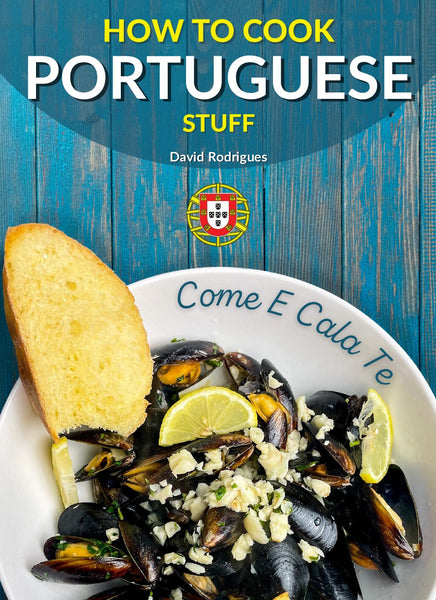
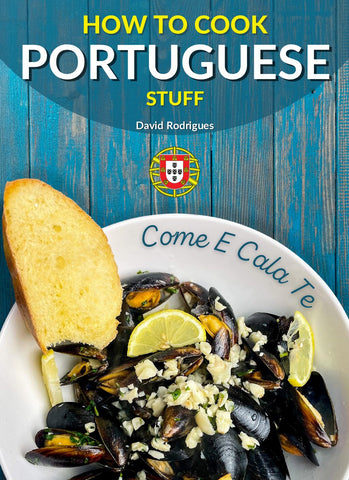
Portugal boasts one of the best cuisines in the world. But Portuguese food can also be intimidating. The days of being afraid to cook your VoVó’s favorite recipes are over, because I’m here to measure everything out, map it out patiently, and put everything into easy to understand English! From Seafood to Meats, from Gameday foods to Desserts, I’m covering all of your favorite Portuguese recipes. Impress your friends and family alike, because I can assure you, everyone will be going back for seconds!
Portuguese cookbook with 46 delicious easy to make recipes!
-
 Sold outVisit product page →
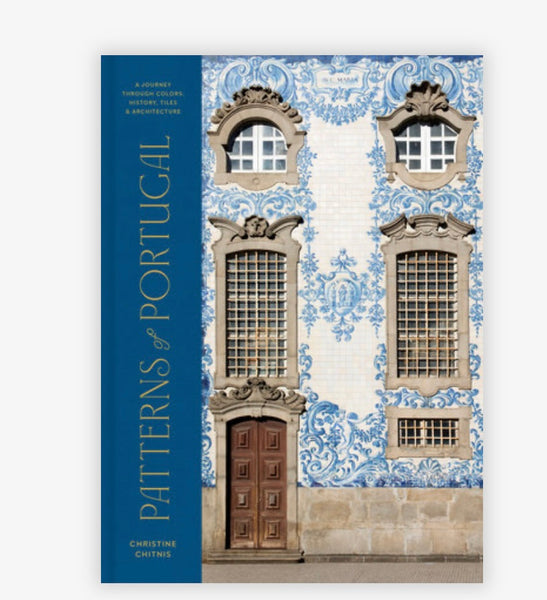
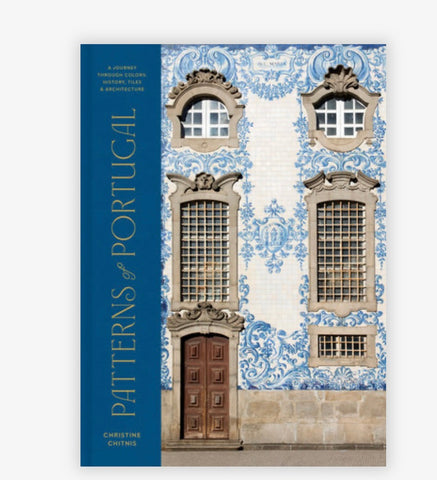
A vibrant tour of Portugal, featuring more than 200 photographs that bring to life one of the most beautiful countries in the world.
In this gorgeous book, writer and photographer Christine Chitnis invites you to celebrate the unique, timeless beauty of Portugal through the stunning designs and hues that define Portugal’s countryside, coast, small towns, and cosmopolitan cities.
This collection features over 200 stunning photographs that illustrate the ways that color and pattern are woven into the very fabric of the country’s culture, history, architecture, and traditions. Each section features insightful essays that explore the artistry of azulejos, the colorful ceramic tiles covering much of Portugal’s architecture; the intricately embroidered details of traditional lavradeira costumes; the rich flavors of Portuguese cuisine, and so much more.
Throughout these vibrant pages, you’ll discover the vivid stories behind each color and pattern, transporting you to the gorgeous fields of Alentejo, the sparkling waters of the Algarve, the busy streets of Lisbon, the lush valleys of the Douro, and beyond. -
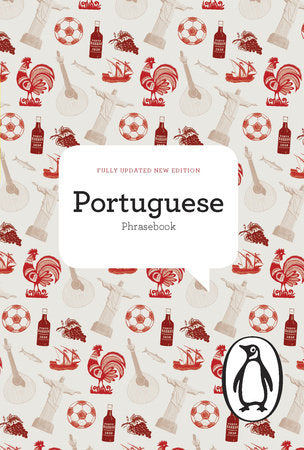
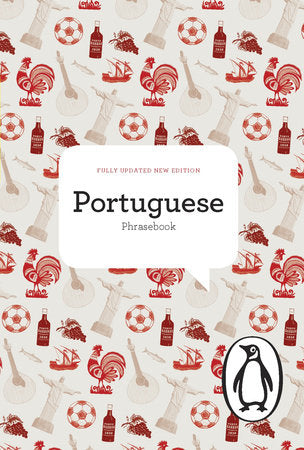 Sold outAn indispensable, fully up-to-date phrasebook for travellers to both Portugal and Brazil, in a pocket-size format and beautiful cover design This newly revised and updated Portuguese Phrase Book contains a wealth of useful words and phrases for travellers in both Portugal and Brazil, with a particular emphasis on Brazilian Portuguese. The book includes basic grammar, a pronunciation guide, additional vocabulary and phrases to suit every place, event and situation. Clearly presented and easy to use, it is the perfect pocket-sized travelling companion. - Essential phrases for travel, eating out, shopping, sightseeing - Numbers, times and dates - Pronunciation given - Grammar basics and vocabulary list - Designed for use in both Brazil and Portugal - Particular emphasis on Brazilian PortugueseVisit product page →
 -
 Visit product page →
Join our book club! We are starting our Saudade Book Club and are so excited to discuss, listen and learn alongside you. The themes will range from identity, to immigration, to gender, to race, to love, to heartbreak, to self-help, to aging. All books will have a thread connected to Saudade, either because it’s a Portuguese author, or about a Portuguese immigrant neighbourhood, or a forbidden love, or colonization, or a Canadian novel which has also been translated to Portuguese. Our goal is to host safe spaces where we connect, share, listen, learn and leave inspired. When you buy one session it includes the book and attending the book club event. We will reveal the book a few days after you join. If you already have the book we will give you a credit note towards another book. . Each book will have a Book Club date held at our shop or at another exciting location. On some book club dates we will be lucky to have the author or a special guest join us. 😍 Let’s be inspired together. ♥️ This is also a great gift!!! You can buy one session for $25 plus shipping or a package of 6 for $140 plus shipping of each book. 4-5 weeks before the date you will receive the book or you can pick up the book at our shop.
Session 1 Nov 18th
Session 2 Feb 10th
Session 3 April 28
Session 5 June 16th
Session 6 Sept 22


v

